Public launch in 2027
Professional Certificate in Combat Sport Coaching
A 10-week, advanced program for coaches working with competitive fighters. Build on applied research to transfer fight-sport specific knowledge.
For experienced professionals who want their coaching to match the reality of the sport.
Point 1:
Champions are built, not discovered.
There are methods with repeatable results that are universally effective and deliver across stages. Waiting for fighters that are cut out, instead of guiding towards winning those who are already there, is missing the main point.
Point 2:
Reputation follows results, career follows reputation.
It is the structured, unbiased approach and the recognizable decision frame leading to repeated success that makes a coach referred, regarded and paid respectfully.
10 modules
3 months
Fighter's success is produced, not hoped for.
The program works systematically through key points of progress, from group dynamics and brain–body–social interaction to competition preparation.
Resulting in clean, defensible decisions as a coach in areas:
— Estimating clients’ skill maturity
— Build rapport, bridge cultural differences
— Optimize for competition results
— Give feedback, handle response
— Develop class structure
— Navigate emotional charge, friction
— Present yourself as a solid professional
Are you:
An accomplished fighter moving into coaching
You’ve proven yourself. New challenge is to make others, too.
A fitness trainer or general coach working with fighters
You know the body. Now you need to learn how it work under extreme pressure.
A sport psychologist entering combat sports
You understand sport, now need to understand combat.
Comparison of certification paths.
| Features and benefits summary column |  General coach, trainer certificates |  Sport, exercise psychology degrees |  GrapplingArc Professional Certificate in Combat Sport Coaching™ |
|---|---|---|---|
| Combat relevancy | Low (unless art specific) | Low | High |
| Learning objectives | Understanding coaching and training frameworks, applying basic exercises | Having a broad overview of human functioning, general psychology, and athletic practices | Understanding combat psychology and fight-sport specifics, coaching high-stakes fights |
| Physical conditioning coverage | High | Medium | Low |
| Internal, regulatory aspect coverage | Low | Medium | High |
| Competition preparation coverage | None | Low | High |
| Entry requirements | Being 18+ and/or a foundational course | Qualifying academic points Background check References Personal statement Interview for personal fit | 25+ 5+ years fight sport history |
| Additional study requirements | English proficiency Digital confidence | Travel to site Additional fees English proficiency Digital confidence | English proficiency Digital confidence |
| Course duration | 2 days–12 weeks | 1.5–4 years | 2–4 months |
| Course fee | $100 - $5,000 | $25,000 - $100,000 | Soon |
| Module based purchase | Rarely | Often | Yes |
| Alternative (free) enrollment | With government support | With scholarship/grant | With case study participation |
| Information source | General textbook | Mainstream academic | Leading academic |
| Handovers and practical tools | Medium | Low | High |
| Mobile ready content | Often | Some | Yes |
| Interactive excercises | Rarely | Yes | Some |
| Certificate issuing | Upon completion | Upon passing all modules | Upon passing all modules |
| Physical certificate and holder | Rarely | For extra charge | Complementary |
| Accreditation | Sometimes | Yes | Soon |
| Qualification level assigned | Sometimes | Yes | Soon |
| Career opportunities | Trainer, general coach | Sport coach, lifestyle coach, health coach | Combat sport coach, specialized competition coach |
| Saturation of profession | Very high | High | Low |
Making your guidance coherent, defensible, and effective.
Entry
requirements.
25+ age
Because coaching requires self-reflection and context recognition.
5+ years combat sport history
Because fight sports require insight to understand the demand.

The curriculum.
Module 1
Coach influence and responsibility
This module defines the coach’s impact on progress and motivation. No learning styles, no mindset. Just clear insight into rapport building, character interference, club dynamics, and logistics.
Module 2
Feedback strategies
This module turns feedback into a strategic tool. When to correct. When to reinforce. When to stay silent. How to handle emotional charge respectfully.
Module 3
The nature of fight sports
This module give a structured way of understanding the varying demands of different art forms, from weapon-based, to striking to grappling, and prepare you to assess fighter-art form fit.
Module 4
Class structure and curriculum
This module breaks down how training transfers to results. What drills survive pressure. What sparring builds knowledge. And how to build a class structure for fast progress.
Module 5
Competition preparation
This module breaks down the preparation into stages. What to start building early and what to add at a later stages. Giving insight into where to look for adjustments when training doesn’t translate into proportionate competition results.
Module 6
Client diversity
This module provides the method to improve client relation across temperaments, reactions, and personal features. Eliminates mislabeling, bias and cultural missteps.
Module 7
Sex and gender dynamics
The module addresses friction before it escalates. It resets the narrative on sex and gender, and gives guidance to build a class with equal chances of progressing.
Module 8
Stress and tolerance
This module clarifies the role of external circumstances and personal history. Helps to recognize windows of tolerance, overload, warning signals, and the point when coaching stops being the right way forward.
Module 9
Age and ability
This module aligns expectations with age groups. Introduce the abilities across developmental stages so progress stays realistic and injuries minimal.
Module 10
Physical conditioning
This module integrates modern conditioning into the coaching framework, discussing how to balance load and recovery, and how to work with periodization.
Bonus
Setting up a coaching practice
This package covers the support required to start strong as a coach. Providing branding and positioning, website and digital infrastructure, client papers and logistics.
For graduates only
The framework.
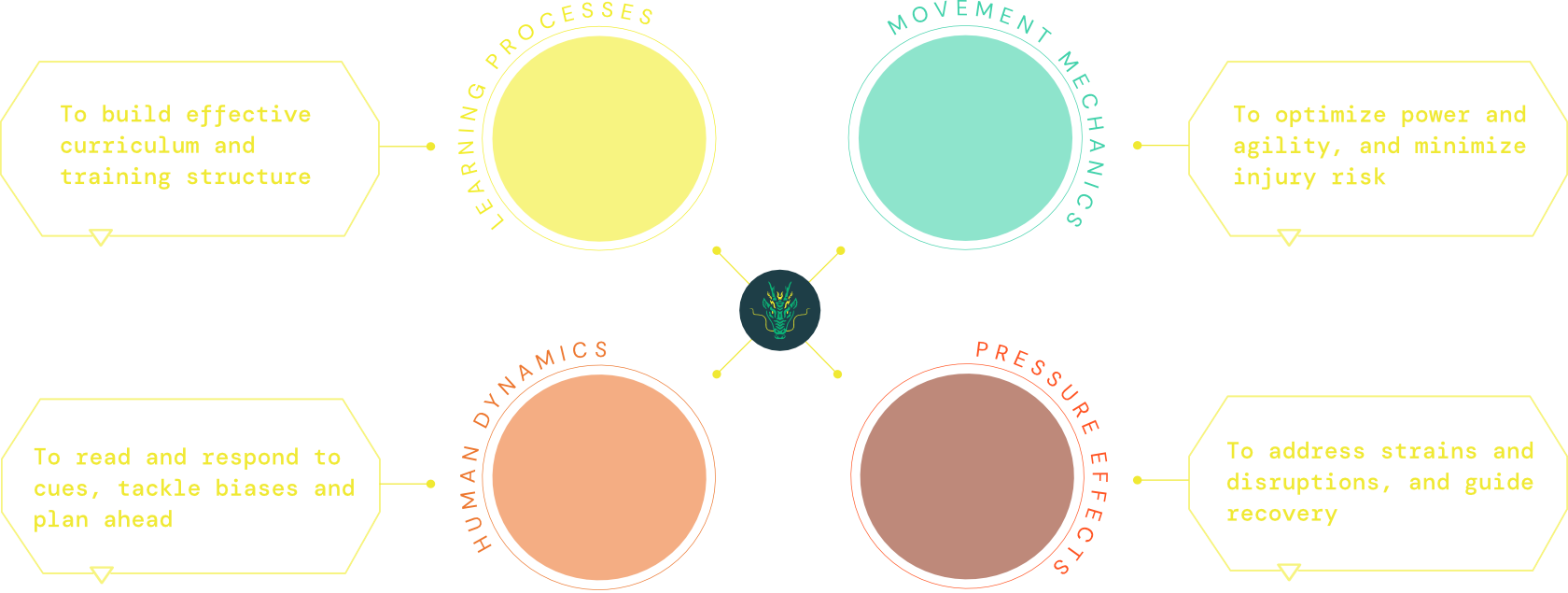
The GrapplingArc combat sport coaching program integrates four domains that decide progress and coaching outcome in fight sports.
Learning processes
How to accelerate muscle memory, what degrades or sharpens under pressure, how to structure training for progress.
Movement mechanics
Body alignment for power and agility. Preventing and responding to injury, recognizing technical blind spots.
Human dynamics
How culture, club hierarchy and personal features affect progress. What and how to adjust to improve results and navigate competition pressure.
Pressure effects
How threat changes perception, how to address stress that alters moves and game strategy, and how fighters recover, adapt, or shift.
Knowledge framework of the GrapplingArc Professional Certificate in Combat Sport Coaching™
Options and pricing.
10 strategic modules that come together as a complete combat sport coaching system, giving you a stable methodical framework to coach fighters safely and effectively towards competition success.
Single purchase
Single purchase
By application only
3-9 seats
10-49 seats
50+ seats
seat number
seat number
seat number
Lifetime access from any device
14-day money-back guarantee
Secure payments and encrypted data
"A person is nothing but what learning makes of them."
This learning gives you a stable practice.
This learning gives you a strong position.
This learning gives you reproducible results.
When you finish:
#1
You’re booked.
Because few coaches understand fight-specific development.
#2
You’re referred.
Because your decisions make sense and survive fight sports pressure.
#3
You’re trusted.
Because knowledge and respect are visible in your work.
Getting paid to help others navigate combat is a serious responsibility.
Structured material
Clear sequence. Real cases.
Practical tools
Used during the program. Used after.
Certification
Issued on completion of all modules.
Frequently Asked Questions
No formal education is required.
The program assumes substantial experience in fight sports and exposure to competition environments.
The program is not a substitute for time on the mat or technical training. It is made for people already inside fight sports and moving into coaching.
No. You can complete the module lessons at your own pace.
Most participants spend and average one week per module, but this can vary greatly based on available time and dept of engagement.
Yes.
The Professional Certificate in Combat Sport Coaching is issued only after all modules and their assessments are completed successfully.
If you complete individual modules without finishing the full program, you will receive confirmation of completion for those modules.
No.
Modules can be completed in any order. Many participants start with topics that match their current coaching challenges, then complete the remaining modules afterwards.
Each module includes up to three exam attempts.
If all attempts are unsuccessful, the module must be repurchased. The assessments are designed to test application and judgment, as opposed to memorization, so deep engagement with the modules is necessary to pass them.
If you have concerns, contact us to help identify where understanding or application lost.
No.
This program does not provide general fitness, strength training, or nutrition qualifications. Physical conditioning is covered only in relation to combat sports and competition demands.
If you wish to offer physical training services, you are responsible for holding any required licenses or qualifications in your jurisdiction for such activities.
Minimal.
Traditional sport psychology focuses on non-threatening sports and group-based performance environments. Combat sports introduce interpersonal threat, injury risk, and different pressure dynamics.
This program addresses those specific conditions and the coaching decisions they require.
At this time, the program is not formally accredited within national or international education systems.
The certification functions as a professional credential, not an academic degree or licensed qualification. It reflects completion of the GrapplingArc curriculum and assessment standards.
Formal accreditation may be pursued in the future, but is not currently in place.
No.
This program does not provide knowledge in therapy, diagnosis, mental health treatment, or psychological consulting. It does not replace licensed psychological or medical care.
Coaches are expected to refer athletes to appropriate professionals when issues fall outside coaching scope.
This program does not replace local legal requirements for working with minors or vulnerable groups.
You are responsible for complying with all safeguarding, consent regulations, and licence requirements for such work in your region.
You can reach us through our contact page for administrative or program-related questions.