

The Brain & Combat: Handbook of Competition Preparation
A 7-chapter, self-guided preparation work for competition-focused fighters. Made to close the gap between training and competing in BJJ, MMA, and submission grappling.
You’re training consistently. You’ve read and watched everything that matters.
But results not there yet and by now:
- No advice changes a thing
- Your head is full of motivational quotes
- Patience is wearing thin
Progress comes fast if the method works.
Because the right inputs change the game quickly. This is what this program does. It reorganizes how you think, train, and respond under pressure.
Noticeable shifts can show up within 1–3 months.
Are you:
Competing regularly or preparing to
Training seriously but seeing uneven results in competition
Looking to stabilize your game under pressure
A prep system that will be your strongest competition asset.
“A lot of what I did before didn’t do much. This did, it changed how I spar and drill, and how I prepare. Next tournament, gold. No hype. Just worked.”
BJJ fighter
“I’d been stuck in competition for years. I finally got here something I could use to progress. My prep changed, my points grow. All good now.”
MMA fighter
“One month in and people noticed. Same gym, same partners, but better game. What stood out was how real everything I read felt.”
Submission grappler
The model behind.
Based on the Tournament Preparation Model for Grappling Arts™, the handbook represents a complete decision-making and preparation system, that breaks down the brain-body alignments relevant to competition results — structured across seven chapters. Includes practical exercises, thinking drills, and illustrations to speed up application.
7 Core Topics
Covering preparation from brain to body
23 Exercises
Guided practices and strategies
50+ Illustrations
Clear visual breakdowns
Chapters.
Each chapter isolates one crucial area that cannot be adjusted by training harder, thinking positive, or copying others. Each piece stands on its own, but the system is the real weapon.
Chapter 1
Strategy vs fit in fight sports
Establishing a framework for competition preparation in fight sports based on the demand and internal processes of different disciplines. Discussing and making fight relevant attributes measurable, this chapter offers a working frame to structure preparation efforts for competition results in grappling arts.
Chapter 2
Confidence: what it does, and what it doesn’t
This chapter goes through the internal processes related to trust in ability, how it forms or collapses, and why it’s often misunderstood in fight contexts. Both environmental factors and brain–body dynamics are discussed via the lens of confidence, to understand what factors matter under pressure.
Chapter 3
At the competition: changes in the brain and the body
A detailed look at the realities, demands and underlying processes of tournament events. Following how internal reactions come together to a final outcome, this chapter discusses how opponents are read, risk is assessed, and responses are selected before conscious decisions are made.
Chapter 4
Long-term preparation for competition
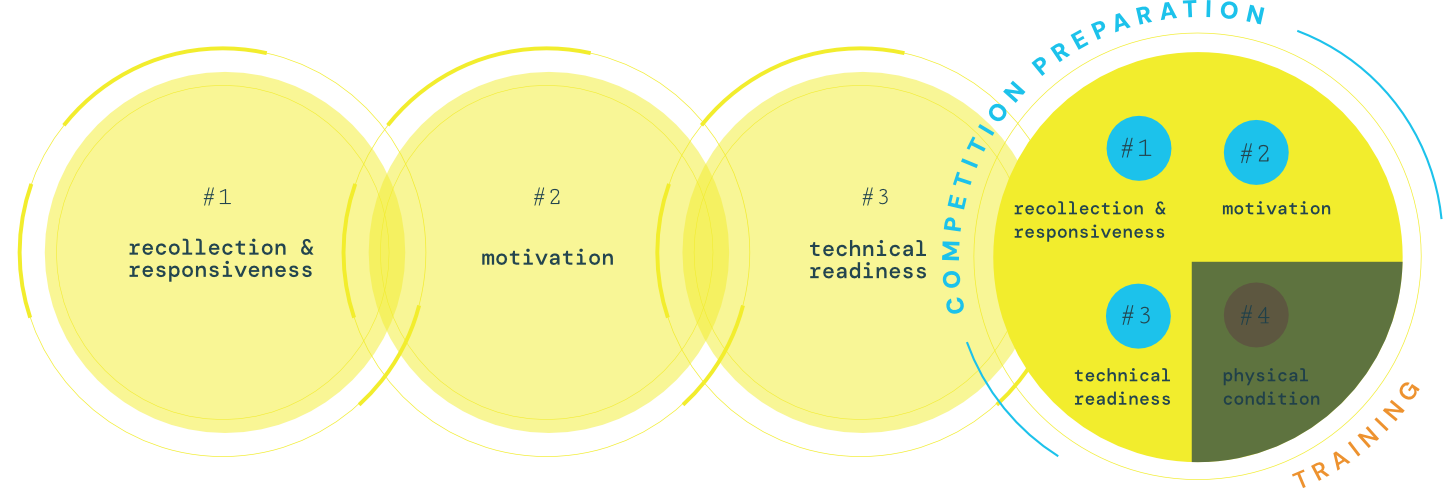
The practical methods offered by this chapter are organized around four preparation domains to cover the internal processes defining competition outcomes. They target fundamental change by aligning brain–body dynamics, refining stress responses, strengthening conflict resilience, and expanding effective muscle memory.
Chapter 5
Short-term and event-day preparation
This chapter complements long-term preparation efforts with techniques applied in the final phase of preparation leading to the event and the fight itself. It focuses on arriving ready and being able to manage external influences, noise, and cognitive-social pressure throughout the competition day.
Chapter 6
Breaking through the silver plateau
Invested efforts with stalling progress are commonly misread as a personal limit reached, rather than recognized as a transition point. This chapter analyzes this pivotal stage and outlines structured options for moving out of stagnation.
Chapter 7
Growing after falling: working with losing
Losing carries more potential than winning, but only if handled properly. This chapter looks at how lost matches affect future ones and how to work with them to get the most out of the experience.
This handbook condenses multiple years of work with fighters and coaches, supported by targeted research into operating under pressure and resilience in close-combat contexts. It was developed as a response to motivational noise, suffer-culture, and quick-fix mindset advice, focusing instead on underlying dynamics and approaches that hold up in competition.
“Competition reveals what training hides.”
but results
just come
and go?
progress in the gym
but blocks
at events?
but at high-stakes
events matches
slip away?
but non moved
things ahead
for you?
A strategic framework built for serious fighters who want a rare edge.
The work done with the Brain & Combat chapters aligns how you process, train, and fight. No theory for its own sake. Everything is meant to have an impact.
Doing what everyone does gets you to where everyone gets; which is not the top.
The Brain & Combat framework breaks the pattern and gets you out from competition traps.
Options and prices.
7 strategic chapters that stack into a complete competition system that permanently changes how you prepare and compete.
Note: This framework enhances individual results. It does not replace professional coaching or club training.
Single purchase
Single purchase
By application only
3-9 seats
10-49 seats
50+ seat
seat number
seat number
seat number
Lifetime access from any device
14-day money-back guarantee
Secure payments and encrypted data
Frequently Asked Questions
The handbook is a digital series of seven chapters purchased individually. After purchasing a chapter, full access to it is unlocked automatically.
In rare cases, access may be delayed for a few hours due to system updates. If access hasn’t appeared within 24 hours, contact us and we’ll resolve it manually.
We guarantee at least one year of access from purchase, even if structural changes in the current access tiers occur.
No formal background is required.
The material assumes experience in combative arts, but concepts are explained clearly and without complex language.
Starting with Chapter 1 is recommended, as it lays out the framework used throughout the handbook.
If you’re preparing for an upcoming event or dealing with a specific issue, you can jump to relevant chapters and return to the rest later.
The material requires attention and practice.
Some concepts may be unfamiliar or contradict common advice. The value comes from working with the exercises over time, as opposed to skimming the text.
Exercises range from brain–body coordination work and adjustments to how you train.
They are structured, step-by-step, and designed to be integrated into regular training.
No.
The handbook does not use traditional sport psychology models. Combat places different demands on the nervous system and decision-making process, and the material is built specifically around those conditions.
Most fighters report noticeable shifts in awareness, self-regulation and training approach within a few weeks.
More stable changes typically develop over 1–2 months as new patterns take hold.
No.
The handbook does not prescribe physical conditioning, strength training, or rehabilitation protocols. It focuses on preparation related to operating and responding under pressure.
The material is written for people training in combat sports.
While some concepts may be useful more broadly, the examples and applications assume familiarity with training and competition environments.
No.
Competition outcomes depend on many factors. The handbook provides tools and structure, not guarantees.
No.
This handbook does not provide psychological or medical advice. It is not a therapy, diagnosis, or medical treatment.
If you are dealing with mental health concerns, injury, or medical conditions, you should consult a qualified healthcare professional.
If questions come up while working through the handbook, you can contact us directly.
If you’re looking for guided preparation, you can explore the Making of a Champion program, subject to availability.