


‘Why do I have back pain when I can do so many sit-ups?’ – A question that comes up regularly, so it’s worth to dive into the details of core workout.
Today, the accepted view on back pain (especially lower back pain) that it’s most commonly comes from weak abdominal muscles. So, working out those muscles, sounds like the right answer to the problem. But is it really? Well, the fact is that the more sit-ups you do, the more you may harm your back. How can that happen?
Where does back pain come from?
Back pain happens when your default posture overuses the back muscles to hold your body together to maintain the frame while sitting or moving. The more those back muscles are stimulated, the more your brain will relay on them for being more familiar, and the more they are going to be used. Basically, the back muscles take over all the work the posture requires from the body, leaving the core muscles undeveloped.
If the resulting back pain becomes more serious or even chronic, you may go and see the doctor, who would likely suggest physiotherapy. The most common advice there is to work out your abdominal muscles in order to distribute the postural work more evenly between different muscles. Although this is not wrong, it is still somewhat incomplete.
Why doesn’t the traditional abs workout work?
In fitness or any physical conditioning, when it’s about working out the core muscles, you’re advised to do a certain number of repetitions of the following common exercises:
- Plank (example: plank exercise)
- Crunches straight or obliques (example: crunch exercise)
- Curl up to sit-ups (example: sit-up explained)
- Russian twist (example: simple russian twist)
Traditionally, you would increase the repetitions until you can’t do it anymore. As Muhammad Ali said: ‘I only start to count {the sit-ups} when it starts to burn.’ However, all these exercises mainly focus on using the recti muscle (also known as the six-pack) and the obliques muscles, not the deepest one, the transverse muscles, which provides the actual core strength.
So even though the expectation from doing sit-ups is to counterbalance the strength from the back muscles by pulling your body forward, you’re actually flexing both your back and core muscles, putting pressure on the spine. It’s like two teams pulling the same rope to opposite direction, and the result is that one side falls flat, or the rope (your spine) gets torn.
By doing this kind of training myself and consequently struggling with serious back problems, I learned to identify numerous problems with the above exercises:
- The main movement is flexing your spine forwards or sideways, which forces the back muscles to resist in order to keep the shape.
- The exercises are often taught without instructing not to flex by pushing the belly out. When the belly is pushed out, you push the organs out and downwards. This creates more pressure on the connective tissues that hold the muscles together, increasing the chance of developing hernias, constipation, and prolapse.
- Doing sit-ups, in particular, is a widely misunderstood abdominal exercise. It might engage the top part of the recti but not the bottom part, while overusing the hip flexors. If you already are sitting long hours at work, doing sit-ups will put additional pressure on your hips, causing harm.
- When teaching plank, a lot of details are neglected, often making it inefficient or doing more harm to the back. The correct way of doing the plank would involve not feeling the pressure on your shoulders, and not engaging your glutes or back muscles, which tend to take on all the work when done incorrectly. Also, you would be able to breathe properly. In this setup, the core indeed works. Otherwise, it just adds more tension to the back.
As you can see, the traditional core exercises, even when done right, put a lot of body parts that were not targeted under intense pressure, while only partially improving the targeted core muscles. When done incorrectly, they don’t just give a poor result, but also can cause serious health problems in the long run.
How to optimize your core training
To reduce back pain and build real core strength, you need to focus on the deepest abdominal layer: the transverse muscle. The contraction exercises that follow are designed to target this muscle directly, making sure you’re training your core itself without overloading any other part of your body.
The transverse muscle is the only muscle wrapping around your torso. It looks like a corset, originating from the six lumbar vertebrae (on each side) and closing at the top behind the recti (six pack) and at the bottom over the recti, maintaining a close relationship with the recti. You use your transverse muscle with every breath you take and everything you do. These everyday movements, however, don’t strengthen it, which is why targeted exercise is needed.
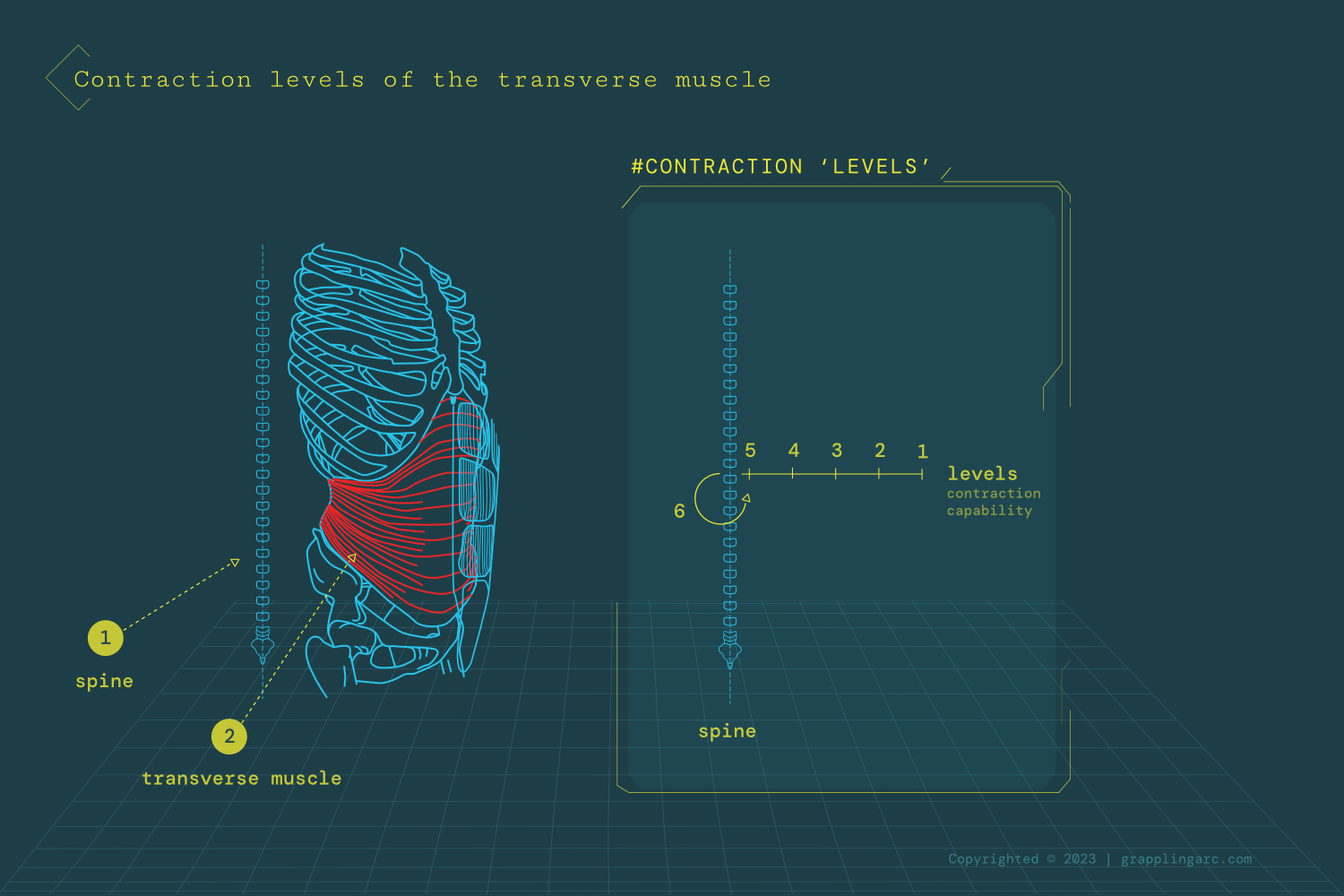
In the illustration below, you can see the position of the transverse muscle underneath the recti, as well as its contraction capabilities, schematized as six levels. Contraction capability can go from light (sucking in the belly button), which represents level 1, to strong, when you contract the entire transverse so much that you would practically feel the muscle around your spine:
- level 1: sucking in the belly button for common vanity reasons
- level 2: sucking in the belly button for a usual fitness exercise
- level 3: bringing the belly in halfway, that makes you feel the length of your spine
- level 4: bringing in the belly as deep as you feel your organs squeezed
- level 5: bringing in the belly strongly enough to squeeze your transverse to your spine but not yet feeling glued around it
- level 6: flexing the transverse muscle so hard it feels like wrapping around your spine
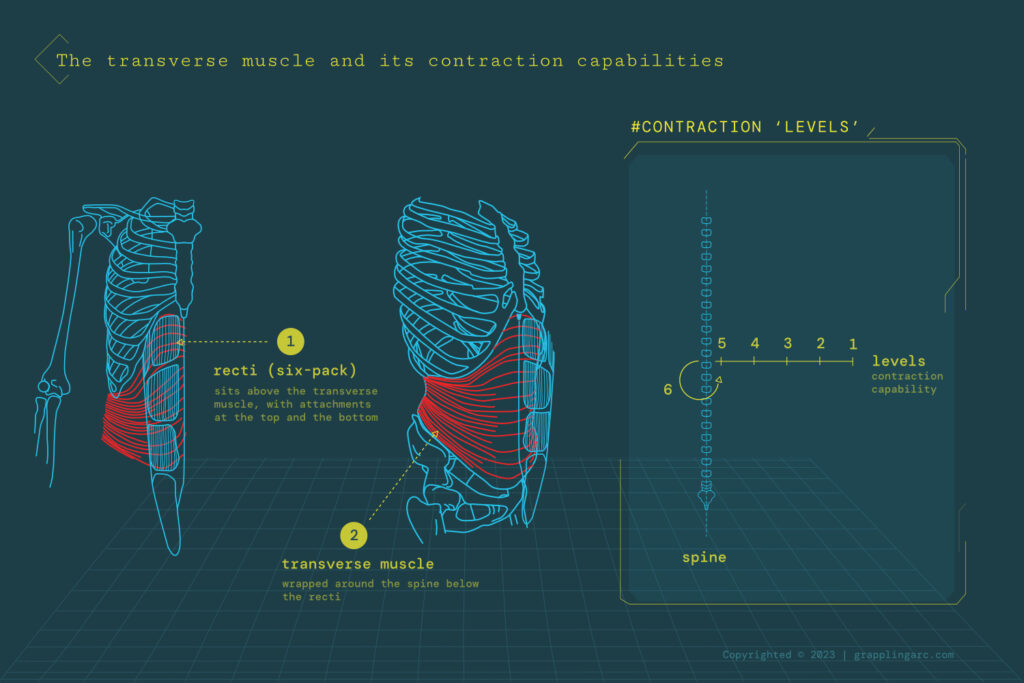
The difficulty is that you can’t stimulate or contract the transverse muscle when it’s in flexion or extension. You need to be in neutral alignment to work with it, which makes the first step of a structured core exercises.
The step-by-step core training
#1 Step: Set up neutral alignment
Neutral alignment requires some intentional effort put into your posture. It can be set up in sitting, standing and laying position, and a few practice of aligning your body parts will help you develop more awareness of what is happening with your body during and beyond your training. These are also fundamental exercises for maximal power output, as these in these alignments the structural muscles are properly connected and you can use your entire body strength for a strike. You can read more about the principles of neutral alignments and their role in a strength and posture in the principles of body mechanics.
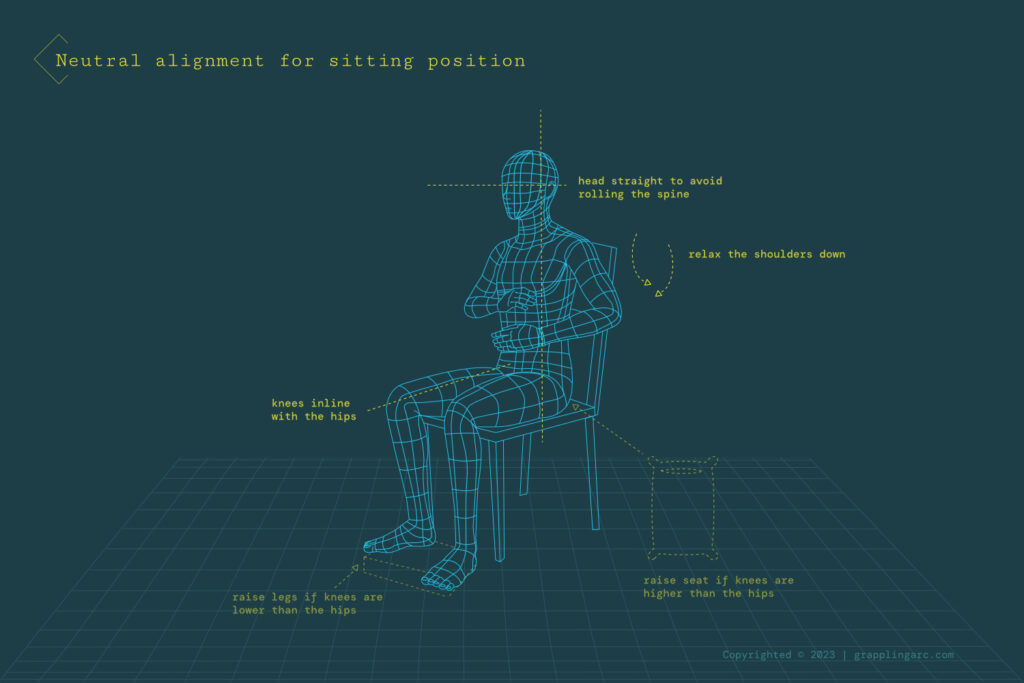
1.1. Neutral alignment for sitting position
- Place your pelvis on the sitting bones
- Place your feet flat on the floor
- Lengthen your spine upward to create space between your hips and your ribs
- Bring your stomach in (such the belly in)
- Relax your shoulders down (not forward) by moving the shoulder blades towards each other
- Keep your head straight, looking forward to avoid rolling your spine
- Place a large pillow behind your back to feel the alignment (but don’t lean on it)
The placement of your knees is also very important to keep the pelvis neutral:
- Case 1: If the knees are higher than the hips, that would roll your pelvis back and flex your spine.
Solution: Add a pillow (or several) under your bum. - Case 2: If the knees are lower than the hips, that would roll your pelvis forwards and extend your spine.
Solution: Add a book (or several ) under your feet.
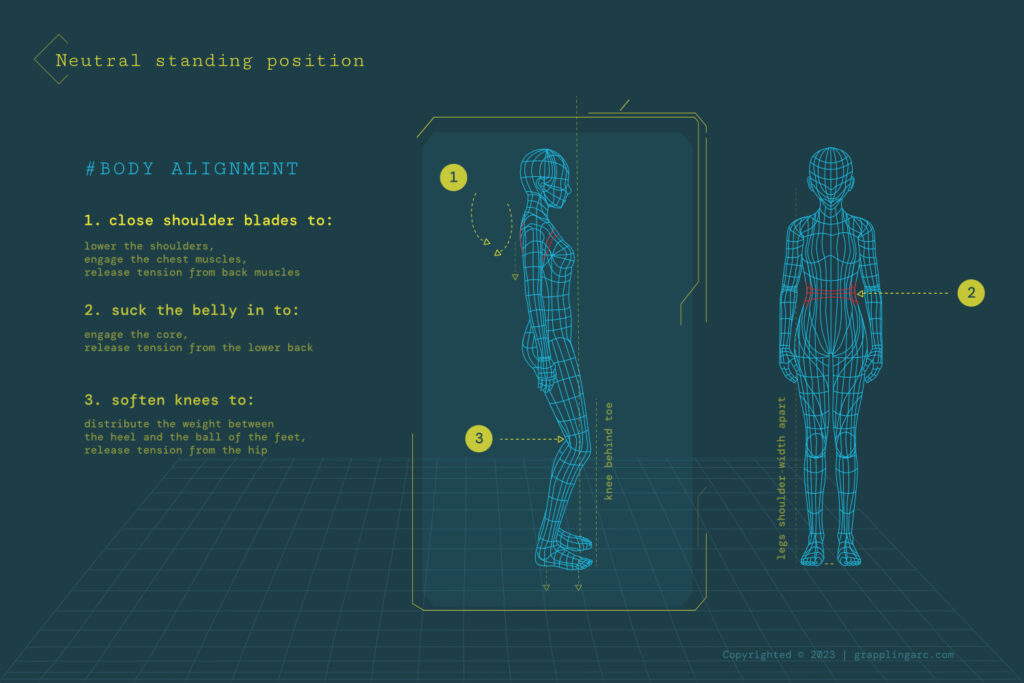
1.2. Neutral alignment for standing position
- Ground your feet on the floor about hip-width apart
- Soften your knees
- Tuck your tailbone slightly inward
- Lengthen your spine upward
- Bring your stomach in
- Relax your shoulder down
- Look forward to keep your head and spine straight
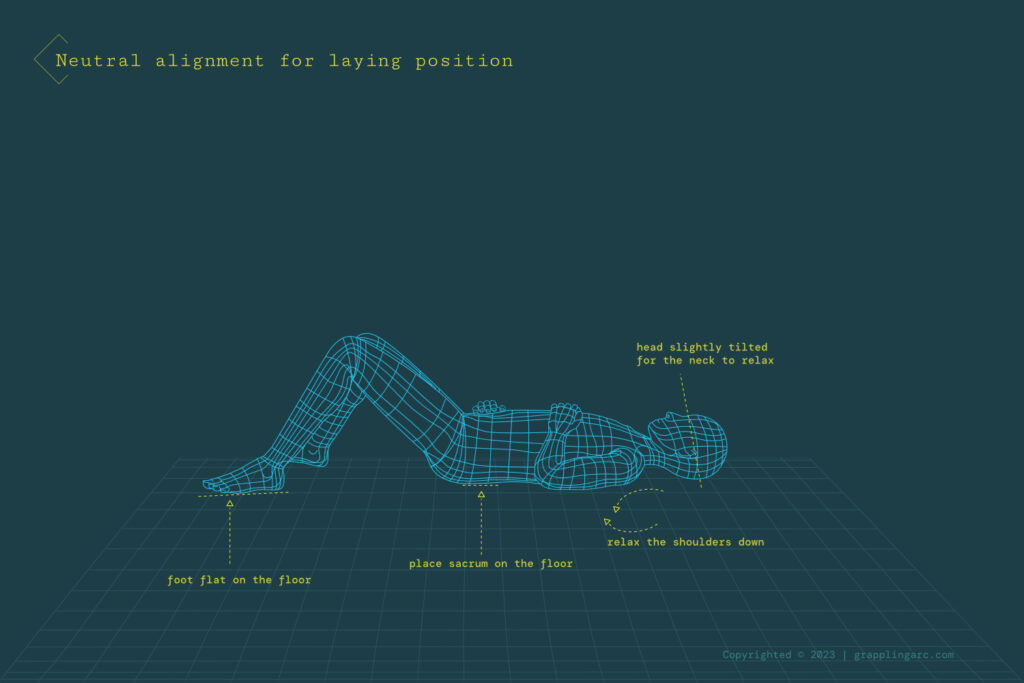
1.3. Neutral alignment for laying position
- Bend your knees and keep your feet flat on the floor
- Place your sacrum on the floor (flatter bone at the end of the spine, before the tailbone)
- Flatten your back on the floor, creating a small space between the lower back and the floor about as thick as your hand
- Relax your shoulders down
- Look slightly forward at the ceiling to make your neck comfortable
Note: To ensure you are in a neutral alignment in all three positions, and to be able to hold them during exercises, you can place one hand on your stomach and one on your lower abdomen. This helps a lot because the transverse muscle has two separate attachments to the recti: one is behind the recti at the top, and the other is all over it at the bottom. If your ribs are pushed out during exercises, that means you are in extension. If your lower abdomen is pushed out, that means your hips are under pressure. Both of these are things we want to avoid during exercise.
#2 Step: Warm-up – The belly breath
This warm-up exercise brings awareness to the transverse muscle and prepares you for the core exercises. While we use these muscle in most daily activity, awareness of how it’s engaged needs to be developed to be able to directly target them with training. The belly breath exercise is a great warm-up doing just that:
- Breathe in through your nose while gently expanding your belly forward
- Breathe out through the mouth and bring the belly button (focal point) toward your spine, into the ‘fifth level’ (strong flex that brings your transverse close to your spine but not yet feeling glued around it)
- Repeat 8-10 times
- Leave one hand on your stomach and one hand on your lower abdomen to check your neutral alignment during the repetitions
#3 Step: Foundational exercise – The transverse hold
This exercise gives you a grip on your transverse muscle and builds up the skills to control the strength of your contraction. The protocol below is described in a sitting position, however, you’re invited to practise it in every neutral position introduced earlier.
- Breathe in through the nose while gently expanding your belly forward
- Breathe out through the mouth and bring the belly button (focal point) towards the spine, into the ‘fifth level’ (strong flex that brings your transverse close to your spine but not yet feeling glued around it)
- Hold it there for a count of 30 — count out loud to keep your breathing steady
- Keep one hand on your stomach and one on your lower abdomen to check your neutral alignment
- Do three sets of three repetitions (3 set X 3 reps) of the above spread throughout the day
Counting out loud is vital because it keeps your chest breathing active and makes sure it’s not getting mixed up with the transverse work. The focus is on holding the contraction and counting out loud without getting out of breath. You’ll feel a warm sensation coming from the transverse muscle as a result of the exercise.
#4 Step: Contracting exercise
This contracting exercise will really make your core stronger. It directly targets the transverse muscle and helps you finetune your control over your core by mixing different contraction strengths. While, during the warmup, you brought your belly into the ‘fifth level’ only, here you’ll work between multiple different contraction levels, so you’ll be able to feel the capacity of your muscle.
The exercise for the first two weeks:
- Breathe in through the nose while expanding your belly forwards
- Breathe out through the mouth and bring your belly button to the ‘third level’. Hold it there as a baseline for the rest of the exercise
- From the ‘third level’, squeeze your transverse to the fifth, count 1 out loud and release it back to the ‘third level’
- Repeat 100x (takes about two and a half minutes)
- Take a belly breath when finished to relax
You might feel a bit sore afterward. It’s normal because you are working on a muscle that has been ignored and/or undeveloped. With the neutral alignment, you’re also challenging how you have been holding your posture for months, years, or your whole life.
The exercise for the third week:
- Breathe in through the nose while expanding your belly forwards
- Breathe out through the mouth and bring your belly button to the ‘fourth level’. Hold it there as a baseline for the rest of the exercise
- From the ‘fourth level’, squeeze your transverse to the fifth, count 1 out loud and release it back to the ‘fourth level’
- Repeat 100x (takes about two and a half minutes)
- Take a belly breath when finished to relax
The exercise for the fourth week:
- Breathe in through the nose while expanding your belly forwards
- Breathe out through the mouth and bring your belly button to the ‘fifth level’. Hold it there as a baseline for the rest of the exercise
- From the ‘fifth level’, squeeze your transverse to the sixth (strongest contraction that feels like your transverse is wrapped around your spine), count 1 out loud and release it back to the ‘fifth level’
- Repeat 100x (takes about two and a half minutes)
- Take a belly breath when finished to relax
The full progressive protocol for month
| Foundational exercise | Contraction exercise | |
| Week1 | 3 sets of 3 reps spread throughout the day, daily | From level 3rd to 5th: 5 sets of 100 reps spread throughout the day, daily |
| Week2 | 3 sets of 3 reps spread throughout the day, daily | From level 3rd to 5th: 5 sets of 100 reps spread throughout the day, daily |
| Week3 | 1 set a day, daily | From level 4th to 5th: 7 sets of 100 reps spread throughout the day, daily |
| Week4 | None | From level 5th to 6th: 10 sets of 100 reps spread throughout the day, daily |
The table above is a recommendation which you can adapt to whatever you feel comfortable with. It is really important to focus on quality over quantity. Because, if you force the contraction when you’re tried, distracted, or lost neutral position, you will not contract the right muscle. So do as many as you still can focus on, and the results will be faster and long-lasting.
Have a great training and stay safe!

The Brain & Combat:
Handbook of Competition Preparation
Learn what turns training into winning. This 7-chapter, no-nonsense program for your head is built to finally get the title you’ve been working toward.
